Here’s a recap of my trip to Rwanda. If you don’t want to read this all, the nutshell is that it was really awesome, and surprisingly nice. There was nothing difficult or “developing” about this trip. Kigali is a modern city and the Agahozo Shalom Youth Village treated me, and all the volunteers, like royalty so it was a really cushy, easy trip with none of the expected complications of traveling in Africa. The kids were amazing and I hope to go back one day. I wish I was there right now.
I took a few photos and you can see them all here:
https://plus.google.com/photos/114082577817315830703/albums/5697450926261234177
Now that I’m home I wish I had a lot more photos, but you have to choose to have the experience or document it. At the time, having my camera out was often a distraction.
Getting there:
I flew from CHO to Dulles to Brussels for 8 hours, then had 5 hours in BRU waiting to fly 8 hours to Kigali, so the whole trip was long and tiresome and I didn’t know if it was day or night when I landed. The most unpleasant part of the entire experience was the flight to Brussels. I was in “deep coach” seated next to an old, skinny middle-eastern guy. He moved and tossed and turned constantly, elbowing me with every motion, but what really bothered me was what I’ve termed his “TB-Rag”. He had a stained handkerchief that he coughed productively into every few minutes. In between hack sessions he tucked this rag into the seat back tray table and then closed the tray, leaving the cloth dangling by one edge. Then he would take the other edge and fluff the fabric, as if to best spread his germs throughout the plane (or perhaps to dry it out.) It made me gag and compulsively use my hand sanitizer for the entire flight.
I had inadvertently told Orbitz that I wanted vegan meals for the trip when I purchased my ticket. This was awesome and I totally recommend it for anyone traveling internationally. First off, ‘special’ meals come out first, so I got my meal before anyone else and the selections were really good and much better than the rubber chicken pasta everyone else was offered: Bulgar wheat and grilled veggies, soy chocolate pudding, fresh fruit. I’ll be flying vegan from now on.
For some reason, the sun comes up in Belgium at about 9 AM this time of year. That was pretty disorienting.
The flight to Kigali was uneventful. I reread Night and The Diary of Anne Frank. I was trying to remind myself about children’s first person reflections on the Holocaust as a sort of perspective for the upcoming trip for the Genocide museum in Kigali. I had recently read a couple books on the Genocide to be a bit more informed before my trip: We Wish to Inform You that Tomorrow We Will Be Killed with Our Families: Stories From Rwanda and As We Forgive. I knew the trip to the museum was going to be difficult. Humans really are the worst.
Kigali:
Once I arrived in Kigali, I went through passport control easily and then retrieved both my checked bags, which is pretty good luck. 3 of the 4 short term English volunteers had all their bags make it. (One volunteer had one bag, unfortunately for James with most of his clothes, delayed about 5 days.) For whatever reason, we were warned that flights into Kigali are a bit less reliable with luggage than you might be accustomed to. The Kigali airport is not unlike the other airports I am spending a lot of time in these days: Knoxville, TYS and Charlottesville, CHO: small, tidy, and efficient. Kigali Airport has 3 gates, elaborate security and a Bourbon coffee shop. (Coffee is a big export of Rwanda, but Rwandans typically drink tea so coffee shops are something of a novelty and are filled with mostly tourists and expats.)
After I got my bags, I was picked up by Mara, the volunteer coordinator, and met the other volunteers. Mara had a van waiting for us to take us to a house the foundation uses in Kigali. It was about 9 PM. After dropping off our luggage we went right across the street to Dolce Bar for pizza and beer. At this point, Kigali felt a lot like any US city in the South. It was warm out. The pizza was good. People were out drinking beer and eating pizza at 10 PM on a Thursday evening. After the food, we were all exhausted from the long travel day. We went back to the house and went to bed. I quickly passed out but woke up with a headache* at 3:30 AM for the day. (For more on this headache and many others like it see my separate section below on Malarone.)
We had a day to explore Kigali before our planned short van ride east to Agahozo Shalom that evening. Mara got us some treats for breakfast that included Rwandan style donuts (not as sweet, 5 times as heavy) bananas and yoghurt.
We spent the morning walking around getting a sense of the city. We changed money. Rwanda is a little behind on the ATM network. Anywhere else you travel in the world, avoid exchange bureaus that usually charge you a higher fee than your bank will, and often don't have the best rates and just use the ATM at the airport to withdraw local currency. It works in South Africa, all over Europe, Australia. In Rwanda the ATMs aren't connected to the intentional network (that Pulse or Cirrus icon on your bank card.) ATMs in Rwanda are for Rwandan bank accounts. That's it. Not you. So you have to go to one of those sketch little exchange bureaus. I did that. It was fine.
Walking around Kigali was really pretty. There is no trash. They have no fast food or plastic bags and as a result I saw almost no litter. The gardens are all very well manicured. There were a lot of people employed in Kigali to work on the gardens and lawns. Most of the people I saw working were trimming lawns and weeds by hand. It looks painstaking. I'm not sure if this is because the implements of the genocide were mostly common lawn machetes and no one wants those tools around in plain view to bring back up the memories, or if because it takes a lot longer to do the work by hand and the government wants to create as many jobs and keep as many people busy as possible.
Kigali is very hilly and the homes are built precariously up the steeps slopes of the hills. There are green lawns and flowering trees everywhere. The streets were crowded with people going to work or going to lunch. Rwandans dress more conservatively than Americans, even with the heat. Some women had silent babies tied to their backs with a bright piece of fabric. Some men were carrying goods on their heads.
We went to a buffet style restaurant for lunch that had rice, beans, potatoes and various cooking bananas and some stewed beef. This is a fairly traditional fare for Rwanda. They will also eat goat brochettes. Baaa. (Not pets.)
There are a lot of transit options in Kigali that range from more to less formal. There are large buses that go to all parts of the country and sell tickets. There are hotel-type vans that go to specific parts of the city and are covered with totally random advertisements to encourage use (images of Eminem, Kanye West, Manchester United and Arsenal were common choices). These vans are cash only and will wait where they are until they are full, and by full Rwandans mean so overstuffed that no one can move or breath. There are also Motos everywhere. Moto drivers drive mopeds around with spare helmets and will give you a lift for hire. You can describe how far something is by the cost of the moto ride. "It's not far, about 500 Francs on the moto." Motos observe some traffic customs and eschew others (waiting at lights) and are, of course, totally unregulated so sometimes break down or run out of petrol or get lost enroute. I only took one moto ride and it was super fun and more than a little exhilarating, especially on the steepest hills.
We took motos to the Genocide museum. [This is that part of the movie where the needle scratches the fun pop song that was playing while the tourists weave in and out of traffic. Obviously, the genocide museum was a tone change.]


That's me reflected in one the numerous unfathomable vignettes around the grounds of the Genocide Museum.
I thought I was prepared. I had reread historical summaries. I had learned about the root evils of colonialism and the short term political power struggles. I knew about the massive hateful national media propaganda campaigns. I knew that nearly a million people had been murdered brutally in about 100 days. I even knew that the US and the UN had good awareness of what was happening and did nothing to stop the slaughter. Of course, one cannot be prepared for the unimaginable.
The Kigali Genocide museum is on the site of a mass grave for a quarter of a million victims that were Tutsi, or Hutu moderates, or unwilling to commit murder themselves or simply in an unlucky place. The grounds are decorated in beautiful gardens in tribute to all those who lost their lives. The museum lays out some historical background about Rwanda, describes the events that led up to the genocide and then details the scope and breadth of the slaughter. I was prepared to learn about killing. I was shocked to learn about so much torture. So much willful pain added to the process. So much suffering.
When I think about the worst, most gruesome horror of fiction, it really can not come close to real life. There were organized efforts for those infected with AIDS to rape Tutsi women and and let them survive so that the community would be burdened by the AIDS epidemic for generations to come. Radio stations blared that anyone seen taking pity on children was weak, untrustworthy and should be killed. There are victim testimonies of bands of genocidaires finding a clutch of hiding victims and chopping their feet off with machetes first so that none could run away and then slowly, inefficiently hacking them to bits to exact as much pain as possible. That is even why the testimony exists at all, because instead of killing the group quickly and moving on, the genocidaires, in this instance, took so much time torturing that they actually ran out of time, and didn't finish everyone off. Something else interrupted them and they were force to leave and search a new location and some of the now footless victims crawled away and somehow survived to describe recount the ordeal. Incomprehensible.
There are many stories of people trying to take refuge in churches. Rwandans are very religious and observant. They went and holed up in churches, so churches are the sites of some of the largest massacres. In most cases their priests and leaders did nothing to protect them when the killers came. In the worst cases they took up the cause. Here's a quote from the museum that is one of many troubling examples, "In Nyange, two thousand congregants were sheltering in the church when Father Seromba gave the order to bulldoze the church building. He murdered his own congregants in his own church." This or worse happened in case after case. I was shocked throughout my visit about how religious and observant Rwandans still are, despite how badly their churches failed them in their most dire hours.
The thing that really strikes me about all this is that I know from my basic corporate work how hard it is to get anything done. Even when everyone agrees something is a good idea there are usually several meetings on plans and strategies and another follow up meeting to see why it still hasn't been implemented. This kind of massive suffering, enacted on such a scale took planning. Lots of planning. There must have been meetings of the AIDS spreading committee. Strategic goals for the machete distribution task force. There were action items. There were follow ups. This was not a horrible, impulsive, crazed act. This was a careful plan, that 'worked' incredibly effectively. It is really hard for me to imaging human beings attending those meetings. Working on their action items. It goes beyond the lazy kind of evil and ignorant kind of evil that I can comprehend. This busy, productive kind of evil is much more frightening for me.
The Genocide Museum is hollowing and shattering. There are rooms of victims' skulls and bones. Rooms of vignettes of what happened to children. There is also an interesting effort by the Aegis Trust to place the Rwandan Genocide historically among the great atrocities of the twentieth century in Armenia, Cambodia, Nazi Germany and the Balkans. This section for me was particularly depressing. Genocide felt common, probable. It felt like rolling doubles in Monopoly. Sadly, a common response to this section of the museum, which is not intended to be exhaustive, is that some other candidate event was not represented. There are a lot more genocides than space in the museum...
I cried a lot and it was time to go.
Malarone:
Malarone is a common malaria prevention medication. The guide books list malaria as the biggest health threat in Rwanda because the country has a tropical climate and plenty of mosquitoes. Travel doctors recommend you take a malaria prevention medication. I was offered three choices, one that causes depression, paranoia and vivid nightmares (Mefloquine), one that causes extreme sun sensitivity (Doxycycline) and Malarone, which can cause stomach upset. I went with the Malarone. You’ll recall I have something of a tendency for headaches and stomachaches. I had a splitting headache pretty much the entire first 4 days of the trip, which was increasingly accompanied by nausea and sour stomach. I was exhausted each day, and would pass out for an hour or two when I went to bed, and then be awakened with a railroad-spike-in-the-brain style headache that kept me up from 1:00 AM all night, tossing and turning and sweating and listening to mosquitos buzz. I was really worried I would feel bad my entire trip and also it was a little harder to feel I could get control of the headaches than at home. At home, for a headache like this I would take some Tylenol, drink a cold ginger ale and watch Sports Center. By the time the Top 10 plays comes around I'm usually feeling a bit better. Here there was no cold drink and no Sports Center on ESPN, and the Tylenol didn't seem to help. I decided to quit taking the Malarone. (Sorry Mom.) I felt better pretty much right away. I decided that if I got Malaria, I would't have symptoms until I got home, and I would get treatment easily in the US and it would be easier to deal with. I never really had that many mosquito bites anyway. I hope I didn't catch Malaria, but I'm glad I felt better for the rest of the trip.
Agahozo Sholom Youth Village:
After the Genocide Museum, we went back to the Kigali house for our luggage and loaded up in a van for the ride to the village. The countryside is lush and beautiful the entire ride and we saw simple homes and crops being cultivated in the fields: sorghum, corn, bananas and coffee.
I was so impressed with the village. I'm not sure what I was expecting, but the village is really, very nice. I stayed in a guest house that was a lot like a nice college dorm room. I had a twin bed with mosquito netting and storage space in a cabinet in a clean spacious room that I shared with two other English volunteers. We had our own bathroom ensuite. Everything was clean and new. The entire village is landscaped with beautiful flowers everywhere. The students stay in 16-person houses, four to a bedroom in bunk beds with another room for their house mother and a group living room. They will live in that house all four years they are in the village together with their new family. All of the structures in the village are new and in good repair.

This is the gorgeous guest house I stayed in.
The village is an amazing facility. It covers everything these kids need to be healthy and heal and visualize bright futures. The kids live in furnished homes in the village. There is a health clinic to care for the students. There are music and art enrichment centers, a science center and a computer lab. There are basketball courts, volley ball courts and soccer field and a track. There is an outdoor amphitheater for performances.
The village has a working farm that grows bananas, pineapples, beans, avocados, coffee, corn, chickens for eggs and cows for milk. The farm doesn't quite grow enough to feed the 500 or so students and staff that eat three meals a day at the village, but it is a strong supplement and the farm is still expanding and becoming more productive. {There is an effort at bee keeping on the farm that is struggling a bit at this point. I was able to go on a fascinating bee keeping demonstration to see the hives, several of which had been infested by a pest and no longer had bees. Another challenge to be addressed by the staff and volunteers at ASYV.}
Meals are served at a large dining hall that also functions for assemblies. Meals are served family style. I got to sit with the kids at meals and they were a lot of fun to talk to. Breakfast was a roll, tea and some porridge. Lunch and dinner were typically some variant of rice, beans and potatoes or cooking bananas, though occasionally there was salad or a vegetable stew. Some of this kids were not used to regular meals, and being able to serve themselves and would pile their plates unimaginable high with rice. The staff would just remind them that the meals would be there again, three times a day every day, but since these students had just arrived they were still getting acclimated and learning to trust.
When I arrived on Friday January 30, the newest students had just arrived at the village from all over Rwanda. They were meeting each other, fitting in to new families and learning about Agahozo Shalom. They had only been there for three days.
Somehow, the next day, for New Year's Eve they were able to put on an amazing talent show in the assembly hall. There were several traditional dance performances, traditional drumming, singing and sketches. It was incredible to see how talented these kids were, and how quickly they were able to work to pull together their acts to bravely put on for their entire class. The director of the school gave an invocation wishing the students the best in the coming year and hoping that they would make the most of the opportunity available to them at Agahozo Shalom. There was a traditional count down (Ten! Nine! Eight!) and then much hugging and celebrating about the new year. The kids had a dance party. Its funny who is popular in Rwanda from America, the kids all seem to like Justin Bieber (even the boys) and Rihanna and Chris Brown and Jay-Z and Beyonce.
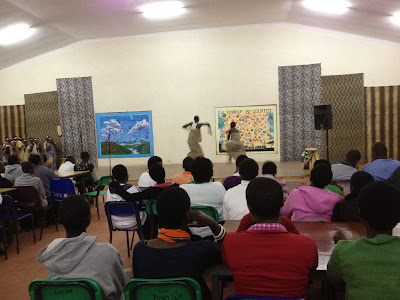
Two boys dancing traditional at the New Year's Eve Celebration
On Sunday, New Year's Day, most of the children when to a nearby church of their denomination and the volunteers worked on our English curriculum for the next week.
The school in the village has a three year high school curriculum that is preceded by a single enrichment year that helps all the students get to a similar academic place so they can do the coursework for the school. They have widely varied academic backgrounds coming in to the program. The students have different levels of comfort with English, which is especially critical, since all of the classes in the high school are taught in English. {Rwanda recently went from teaching most classes in French to English, so some of the children are more fluent in English than others. Some are more comfortable in French. Rwandan's all speak Kinyarwanda at home, so these students would all be working on a third language.}
All of the new students were divided, based on a brief assessment, into three levels of English speakers (introductory, intermediate and advanced). I was assigned to a group of introductory English speakers with two of the longterm volunteers. We had about 22 students in our group. We worked with the students for 3-4 hours per day. My group was very new to English and was working on the Alphabet, basic vocabulary for around the home, school and village, and basic verbs. Over the course of the week the students all worked very, very hard and improved to be able to have a basic introductory conversation. In contrast, some of the other sections were so advanced they were discussing world leaders and different concepts of power. For our section, obviously we were't going to teach them English in one week, but my goal was to give them some confidence and extra practice on a few vocabulary ares that would be really useful to them. I also really wanted to focus on having the students practice and work with each other. A lot of Rwandan school is traditionally lecture based and does;t have that much participation. This was an opportunity for the students to get some comfort in expressing themselves and working with each other. Some were just so quiet and shy. It was great to see them practice brief skits in English by the end of the week. We also had some fun drawing pictures and labeling things, playing Simon says, playing bingo and dancing the hokey pokey.

School Vocabulary Bingo
Each class, I was amazed how positive and friendly and earnest all of the students were, despite having had such instability in their lives. I really doubt any class of 14-16 year old American students, any honors class, could have been that well behaved, that focused and on task and willing to try anything. These kids had only been at ASYV a few days! I am sure when they graduate in 4 years they will be ready to take the world by the tail.
Even though I only worked with them for a few days, I became really attached to my students and quite proud of them. It was very sad at the end of the last class and several of the students made me farewell cards that I adore. I wonder what they are doing now.
ASYV is a truly amazing place. They give children a life and a future. If you have any interest in helping support this foundation, you can donate here: http://www.asyv.org/donate.html.

Here's me with most of the students from my English section and the two long term volunteers who also taught my section.
A bit more time in Kigali:
On the way home, I spent another night at the house in Kigali. I went out with several of the volunteers for delicious and super-cheap Indian food, better than anything I ate when I lived on E. 6th St./Little New Delhi. Before flying out the next day, I went to a crafts co-op to get some jewelry and cute little things for my nieces. I also got a painting of sorghum being harvested that I am having framed for the apartment. There was time for one last farewell lunch at a really nice western-style pizza place, New Cactus, and then I headed out to the airport via a taxi.
The trip home:
I was sad to leave. I was just only well and truly over my jet lag and Rwanda is a really nice place to be. The flight boarded a bit late. Some people flying out of Rwanda are taking every possible thing with them, so there are lots of over-sized carry-ons spilling out their contents on the floor and in the aisles. There were the usual spate of crying babies.
On the plane, the flight attendants spray bug spray inside the plane after the doors are closed but before take-off to try and stem the spread of malaria. It smells like cherry flavored baby-aspirin. My route home from Kigali stopped over for a couple hours in Entebbe, Uganda. Then back to Brussels. More vegan food and silly movies (The Help, Dolphin Tail). I had 6 hours to kill in BRU. I had some breakfast and hung out for a long time in duty free, browsing to kill time. They have many varieties of foie gras in the Brussels duty free. Imagine boarding the 8 hour flight home with that, and a spoon?!?!?!?
The flight back to Dulles included several moms flying with 4 or 5 kids each under the age of 8. The moms were outnumbered and quickly overrun, as was the plane. I gave up on sleep or concentrating enough to read and watched lots of movies: (Contagion, Cedar Rapids, Crazy Stupid Love, Horrible Bosses). I was stuck in the Cs.
After I landed in Dulles, passport control took over an hour, just because it was a long line. I was at the desk for 5 seconds and they didn’t ask me any questions. Customs was even quicker, grab bags, no questions. No sniffer dogs, which surprised me. Instead of taking my connecting flight to CHO after another 4 hour layover, Dave offered to come pick me up (which was more than 5 hours of driving for him)! However, even though I was leaving the airport, you have go back through security to get into the airport to leave. (Thanks Dulles!) That took another hour or so. I was so tired from all the traveling. Finally, I am dumped into the C terminal and can take a train to the exit. I was really glad to see Dave and glad to ride home in a car instead of waiting more at the airport. It was wonderful to not be in a plane.
It was great to get home and take a long hot shower, do my laundry and work on getting back on Eastern Standard Time. I came down with a nasty cold (fever, cough, headaches) about my second day back in the country. I’m not sure if I caught that on one of the fights or when. I’ve felt pretty crummy since I’ve been back, hence the delay in posting my recap here on the blog. I think I am starting to get on the right side of it, but still feel pretty icky. Maybe that is just my Rwanda Rwithdrawal.


